Archive for the ‘Amateur Astronomy’ Category
New amateur astronomers are often tripped up by their own expectations of what they will see through the eyepiece of a telescope. In stating this I’m surely not saying anything the majority of us don’t already know. Anyone who has had the experience of helping a newcomer has seen the consequences of unrealistic expectations. The disappointment can be as difficult to overcome as the expectations are easy to create. Telescope equipment advertising, observing guides, and magazines all persist on relying heavily on Hubble Telescope style images, and these images have come to dominate public perceptions of the Universe studied by astronomers. It’s only natural for the uninitiated, knowing no better, to expect something of the same sort through a backyard telescope. When the telescope fails to deliver, and all of them will fall short of Hubble, disappointment is equally natural.
The truth of the matter is that to human eyes, even aided by a good telescope, the Universe is a subtle place, and it takes time to fully understand and appreciate the beauty of that subtlety. You need to forget the colorful images while at the eyepiece. Then you need to spend time getting past first impressions. Going from one object to another in short order will give the impression that the Universe is a dull place, filled with things that look like wisps of smoke and puffs of dust. Those first glances can be misleading. Don’t trust them! Slow down. Figure on spending more time observing an object than it took to find it. A lot more, if a computer is finding things for you. Look at it straight on, then use averted vision, that trick that has you look slightly to one side. Did that dusty streak suddenly get longer? Or wider? Does the surface of the globular cluster seem to sparkle faintly when you don’t stare straight at it? Didn’t see anything like that? Try again. Try again on another night. Take notes or make sketches to remind yourself of what you saw before. This all takes practice, so the more often you are at the eyepiece and the longer you spend on an object, the better.
It also takes patience. Persisting in the face of initial disappointment takes patience, as does climbing the learning curve you face as a beginning astronomer. It takes loads of patience to sit there and wait for a calm moment that reveals details on Mars, or in a crater on the Moon. Even more to realized there’s truth to descriptions of stars in open clusters being arranged in strings or chains. And it takes patience to let time be your teacher. This will all take time.
But then, isn’t that always the case for a thing worth doing?
 The 2004 solar transit of Venus pretty much passed me by. The job I had at the time left no opportunity to do more than take a short walk across campus and join the crowd gathered outside the Flandrau Science Center. It wasn’t an event, it was a glimpse, and left little impression on me.
The 2012 transit of Venus, the last for more than one hundred years took place this past Tuesday, and since I am currently between jobs I took full advantage of my freedom to observe the event from the start. I set up the Old Scope with a home-made white light solar filter (Baader film, if you’re interested), the whole thing perched on a light-weight equatorial mount set out on the back porch. A foam board shield attached to the telescope shaded my face at the eyepiece, and a carefully propped umbrella protected the mount and my legs. None of this changed the fact that it was early June, in Tucson (Arizona), which is to say that shade or no shade, it was damned hot. The porch thermometer read somewhere over 100°F (about 38°C) in the shade. I wasn’t in the shade, except for that provided by my Makeshift Solar Observatory. The air around me was, to put it mildly, toasty.
I hide in the shade of the porch until a few minutes before first contact, then braved the sun and hot breezes and perched myself on the observing chair. I put an 8mm TMB planetary eyepiece in the diagonal, focused the Sun as well as could be that time of day (rather shimmery image at times) and was immediately impressed by the sunspots sprinkled across the face of old Sol. I checked my watch and was glad to see things were about to start, as I was already wilting in the heat.
Not long after I forgot the weather for a while. An ever-so-shallow notch had appeared in the limb of the sun. First contact. As I watched it very slowly, but steadily, became deeper and rounder, until the shape of a sphere was clearly suggested. I drank water. I poured water (carefully) over my head, and I kept watching. The suggestion of a sphere became stronger as the black spot began to curve back on itself. Eventually a small black bead was visible, not quite detached from the black beyond the white limb of the Sun. It seemed to hang there, tugging gently on that blackness, then suddenly the connection was broken and there was a sliver of white around that side of the bead. There was Venus, and second contact was now a recent memory. I watched, amazed, as the planet ever so slowly made its way across the face of the Sun.
From that point my observations were intermittent. The heat took its toll. I went inside, sat in front of a fan, and absorbed about a quart of iced tea. When I felt refreshed, I went back out and watched some more. Back and forth, iced tea and a fan, and the transit of Venus, until the Sun had set into the neighbor’s trees and was lost to me. I dismantled the Makeshift Solar Observatory and called it quits. I was thoroughly satisfied by the experience. I was also well-done.
A shower, then, and something else cold to drink, though not iced tea this time.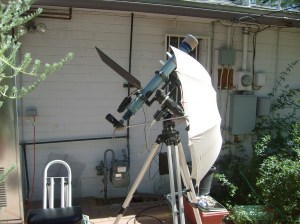
Amateur astronomers often use the phrase “Clear skies!” when closing a letter or an online post. The meaning of the sentiment is obvious to anyone who knows anything at all about stargazing. Without clear skies, you can’t really do much in the way of astronomical observing. Short of setting up a radio telescope, I mean. (And that has been done by amateurs.) But it takes more than a clear sky for astronomy to happen. Other things need to line up just so.
For one thing, the “seeing conditions” need to be pretty good as well. When amateur astronomers talk about “seeing,” they’re concerned with the steadiness of the atmosphere. The ocean of air under which we live never holds still, and at times is downright jittery. You can see this without a telescope. Look up at night and watch the stars twinkle. That’s called scintillation, and as pretty as it may seem to the casual sky-glancer, it isn’t a well-loved phenomenon among astronomers. Telescopes magnify everything, including that jittery glitter you sometimes see at night, which goes from a pretty sparkle on high to a glaring blob of bright mush in the eyepiece of a telescope. When the seeing is bad the sky can be absolutely cloud free and the amateur astronomer will still have limited options.
Wind can be a hardship as well, complicating everything from getting a good view to using a star chart and taking notes. Breezes are fine, especially in mosquito season, but a good stiff wind battering the tube of a 203mm Newtonian reflector does not make for a fine night out, if your goal was stargazing. I can always do without wind, when I have a telescope set up.
And of course, there are the closely related matters of having the time and energy to take advantage of a clear night sky, when all other things are equal. Handling expensive eyepieces while in a hurry, or yawning, is not recommended.
Like so many matters of “real life,” then, it’s best not to take the wish for “clear skies” too literally. There’s more to it than a lack of cloud cover. Think of it as the amateur astronomer’s way of wishing you good luck. Something like saying “break a leg” to a performer, only a little bit more subtle.
I went out this morning just before sunrise, telescope ready, expecting this to be the last morning of observing the waning Moon. Turns out yesterday morning was the last day, after all. The Moon was a delicate curl of bright light all of 20° above the horizon, set in a pale blue not quite sunrise sky. Sliding along the ecliptic, it had moved more to the north than down toward the horizon, but the… Sun is rising earlier and the sky was quite bright. Unfortunately that bright sky was infested with thin grey clouds that first robbed the lunar crescent of detail in the eyepiece, then stole the show as the rising sun lit them with sweeping strokes of apricot and gold. What can you do? After thinking I could make out Bailly and the western shore of the Ocean of Storms, I stepped back to take in the beauty of the sunrise and watched the silvery crescent fade into the blue, as the apricot clouds slowly turned white.
The Dawn Patrol is proceeding as planned. So far there’s been one observing session that started between 2am and 3am (MST), and the rest have begun closer to 4am. I’m finding it much easier to rise an hour and a half earlier than normal, rather than to stay up until midnight or so, as I did a few days back. Except for a day that involved high winds in the wee hours of the morning, these Dawn Patrol sessions have involved pleasant and beautiful conditions. Little or no wind, and then just light breezes, combined with mild temperatures between 58°F and 65°F. (14°C and 18°C). The skies have been clear and the transparency good, and as the Moon has waned more and more stars are out and easily seen. And it is quiet, very quiet, in the cool pre-dawn hours. The sounds of the city around me are muted, and on this Sunday morning almost inaudible. No voices, no cars on the street, with only a mockingbird singing loudly in the light of the Moon. He is singing less, now, and starting later, as the light of the Moon fades. Now and then a White-winged Dove awakens early. These calls and songs do not banish the morning quiet so much as define it. The awareness of how quiet the world is at such an hour is accented when the Mockingbird’s last note fades.
This morning the lunar terminator was a complicated thing, in mountainous places rough and ragged, with bright arcs of brightly lit stone and black bays of inky shadow where the divide between day and night passes through cratered terrain. It’s easy to think of the lunar terminator as a simple dividing line between lunar night and day, and where it crosses the surface of maria this may come close to the truth. But more often than not the terminator is anything but simple. This morning served as a fine example to prove the point. Half lit craters with shining west facing walls to the north of Mare Frigoris, with the shadows within clinging as much to the north as to the west. Plato broad and dark and smooth, with no sign of craterlets using such modest aperture (102mm) under mediocre seeing conditions. The lunar Alps presented a crazy jumble of gleaming bright peaks in a black matrix made of the mingled shadows at their feet. Farther south the proximity of craters such as Ptolemaeus, Alphonsus, and Arzachel created bulges of shadow reaching to the light of day, and bright broken curves of light where high crater rims and the tips of central peaks were bathed in the light of the setting sun. South to more heavily cratered terrain, where outlines grew more confusing, and the black bays of intruding shadow were smaller and rimmed with silver light.
Observing the Moon is always about tricks of the light. For this morning’s Dawn Patrol, it added up to quite a show.
It’s a thing I’ve always wanted to do, and life has handed me the opportunity to get it started and then see it through. Starting a day past New Moon I’ve been out each night to spend an hours or so observing the Moon with either a 60mm or a 102mm refractor – whichever seemed most expedient on a given night. (The larger telescope has seen the most use so far.) Each night, when the Moon has risen high enough for convenient observation, I put whichever telescope I’m using on an Orion AstroView EQ mount and go out. With the Moon in the eyepiece, I work my way down the lunar terminator from north to south, identifying craters, mountains, rilles, and other features as I go. I call this process a terminator slide. I’ve repeated the process every night, now, starting on April 22nd. (I missed on the 26th due to clouds.) I have revisited many familiar sights during this set of observations, and seen things on the Moon for the first time. One session each night of this lunation, weather permitting. It’s been something of an adventure.
And now the easy part is behind me. Each night the Moon rises above the horizon later, which means I go out ever later to make the next slide. Now that full Moon has passed (the much hyped Super Moon of 2012), I’m pushing midnight before I can get a good look at the Moon. Tonight, as I type these words, I’m waiting for midnight, a lunar witching hour. Past this point I will be on “dawn patrol,” for it will make more sense to get up early than to stay out late.
Amateur astronomers do the strangest things!
Still working up the learning curve. Just another brief entry with an image to get a sense for what this thing can do, and how to do these things. Likely as not this will all vanish when I start posting in earnest.


 Under Desert Stars